Middlebury College

Venus and Cupid
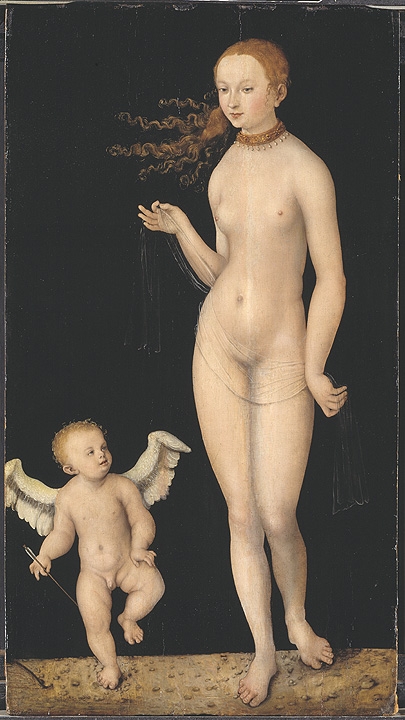
Lucas Cranach the Elder
Venus and Cupid, c. 1520-1525
Oil on Limewood, 90 cm x 49.5 cm
Stockholm National Museum
Lucas Cranach the Elder’s Venus and Cupid (1520–1525) brings together the classical ideals of the Italian Renaissance with the precise style of Northern European painting. Venus’s idealized body, contrapposto pose, and mythological subject reflect renewed Renaissance interest in classical antiquity and the human figure, while the stark black background, sharp contours, and meticulous detail reveal Cranach’s Northern artistic tradition. The result is a distinctly hybrid vision of Renaissance beauty that connects artistic traditions across Europe.
In 1648, Swedish forces seized the painting from the collection of Holy Roman Emperor Rudolf II during the Sack of Prague and brought it to Sweden as war booty. It later entered Queen Christina’s collection, where it became part of her effort to assemble a collection that reflected her intellectual interests and engagement with European art.
For Sweden, possessing Cranach’s Venus and Cupid meant possessing a work rooted in the prestigious artistic culture of the Renaissance. Though created outside Italy, its classical subject and Italian influences connected Swedish collections to the artistic traditions of the European Renaissance. Through plunder, a Northern Renaissance masterpiece became part of Sweden’s growing claim to cultural sophistication and its place within the wider European art world.
Sofia Malmqvist ’28
Lucas Cranach the Elder: Venus and Cupid, c. 1520-1525, Nationalmuseum, public domain