Middlebury College

The Librarian
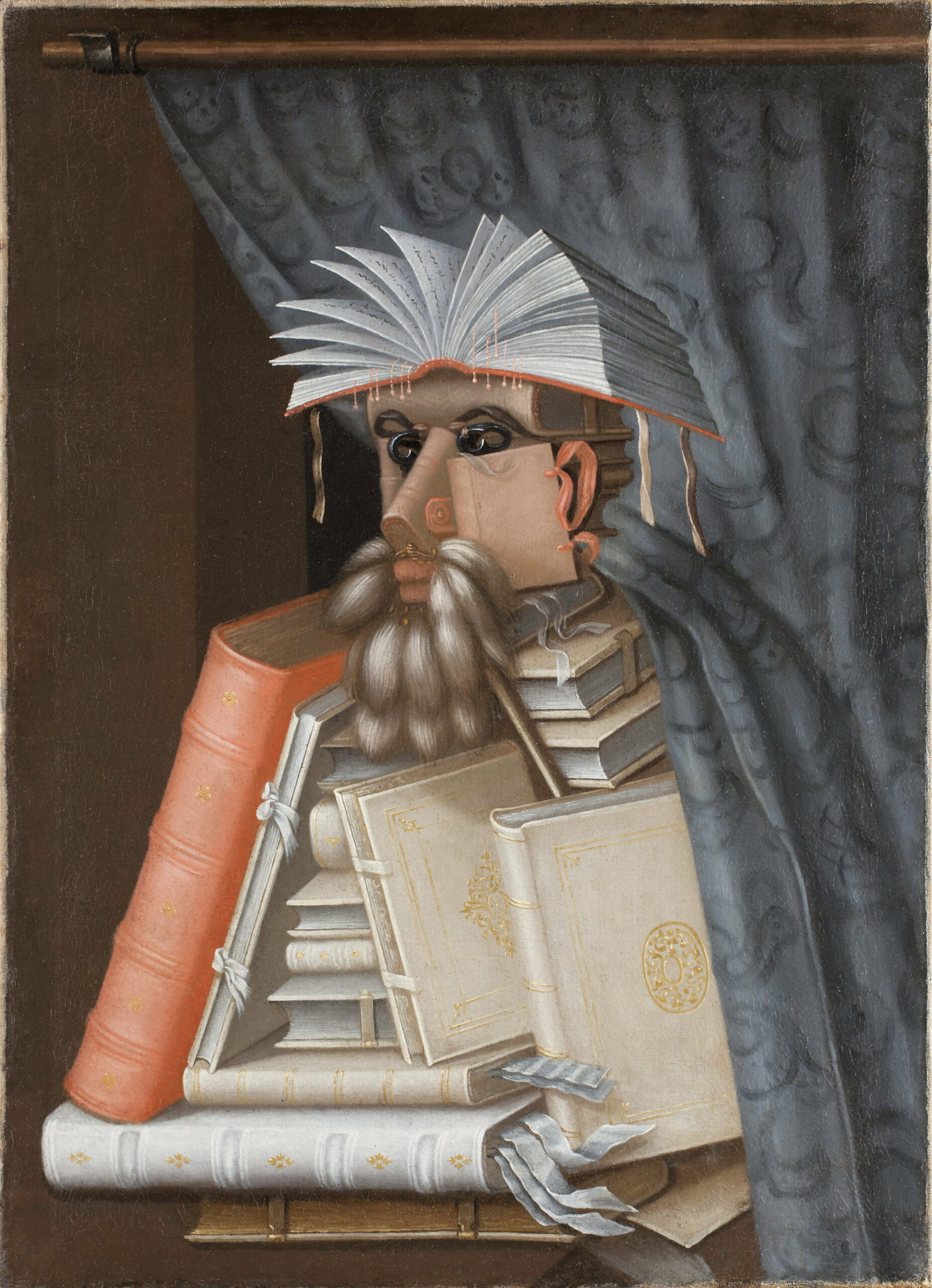
Giuseppe Arcimboldo
The Librarian, 1562
Oil on Canvas, 98 cm x 71 cm
Skokloster Castle
Giuseppe Arcimboldo’s The Librarian (1562) transforms books, papers, and other objects of learning into the face of a bearded scholar. Often interpreted as an allegorical portrait of the Austrian antiquarian Wolfgang Lazius, the work belongs to the playful intellectual culture of the Habsburg court. Arcimboldo’s inventive composite figure, in which objects become a human body, reflects the Renaissance fascination with knowledge, curiosity, and the relationship between art and intellect. The painting’s humor would have appealed to a courtly audience familiar with the scholar it caricatured.
In 1648, Swedish forces seized The Librarian from the Habsburg collections during the Sack of Prague and brought it to Sweden as war booty. Removed from the intellectual world for which its joke was created, the painting entered a Swedish collection and acquired a new significance.
Its presence in Sweden carried cultural weight beyond its whimsical subject. Arcimboldo was celebrated across Europe for precisely the kind of intellectual ingenuity and courtly sophistication that Swedish elites sought to cultivate. By possessing a celebrated work from the Habsburg collections, Sweden could demonstrate its own participation in the learned and cosmopolitan culture of Europe. Through plunder, an inside joke of the Habsburg court became part of Sweden’s performance of cultural sophistication.
Chima Nwaukwa ’29
Upphov: Arcimboldo, Giuseppe. Media: Mohr, Jens. Skoklosters slott/SHM, (PDM)